
COMPUTING
I loved this AI-first web browser, but experts warned me of ‘free’ AI
“If you’re not paying for the product, you are the product.” Bogdan Onikiienko, an ...

The AI industry has blossomed quickly in recent years, and several companies have been in steep competition with one another. Two brands that have especially been neck and neck are OpenAI and Google. These two companies have many services in common within the AI game. Notably, OpenAI has its ChatGPT chatbot and Google has its Gemini tool as flagship features; however, each brand has since launched additional AI services under their respective umbrellas.
Here’s a rundown of the functions and features that ChatGPT and Gemini have in common, and which are ideal to use.
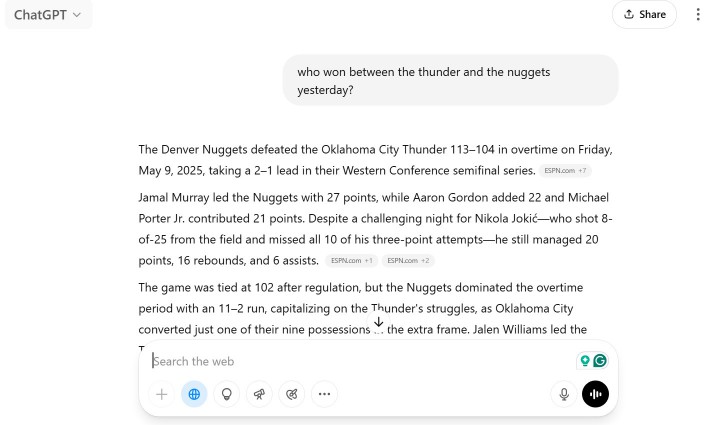
OpenAI launched ChatGPT Search in late October 2024 as a search engine feature within its chatbot that allows users to receive real-time answers to queries, such as sports scores, breaking news, and stock quotes. The feature is essentially the brand’s take on Google Search, which has notably been around since 1998. ChatGPT Search works by allowing you to ask questions in a prompt style and receiving search engine-style results. The company announced collaborations with several news organizations to source content, including The Associated Press, Axel Springer, Condé Nast, Financial Times, Hearst, News Corp, Reuters, The Atlantic, Time, and Vox Media. At the time, the launch also sparked rumors that OpenAI was considering building its own web browser; however, that development has not come to fruition.
Meanwhile, Google Search relies on keywords to give you the results you desire. However, Google has since inundated the search engine with AI updates, allowing it to better process contextual sentences as prompts and return applicable results.
Who does it better? Google Search
I used a recent Denver Nuggets and Oklahoma City Thunder game to test the two engines and found Google Search to be more comprehensive overall. Using “thunder vs nuggets” as a keyword, I got an information smorgasbord from Google Search, including an information card at the top of the search on desktop with the final score of the game and other vital details, video highlights from YouTube, followed by links from the top sports publications and community pages such as Reddit. While ChatGPT Search gives a good text summary of plays, final scores, and past and future games, the multimedia aspect is missing. Google Search just feels more alive.
ChatGPT announced a shopping feature as an add-on to its search in late April 2025, where you can simply select the search icon and then input a query about the item you’re looking to purchase. The feature is available for ChatGPT free, Plus, and Pro users, but with some notable limitations for free users. I noted that images are optional for some searches, while I’ve seen the press images from OpenAI show image cards of the products similar to a Google Search layout. I only got a result with images when testing a search for a discontinued Bath and Body Works item called Velvet Sugar. All of my other shopping searches were text only on my free account.
ChatGPT shopping consolidates purchase options to up to five selections and details pertinent information, including prices, discounts, style options, specifications, best shopping websites, and best locations to shop in the area. You can also click away to the webpages or ask ChatGPT more questions about any product on the list.
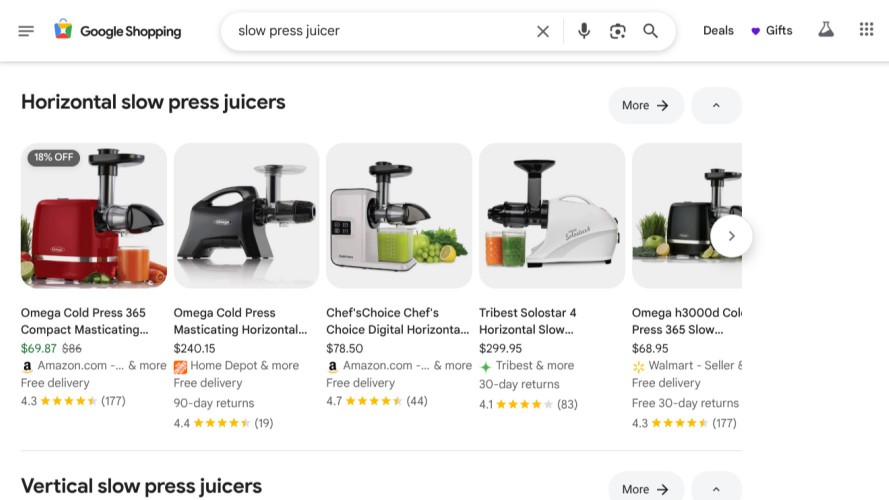
In contrast, Google Shopping is another long-established feature, which launched in 2002 as Froogle. It has gone through many iterations, including its own AI updates, and provides you with several choices. I did another search for a slow press juicer, and under those results were filters, “masticating,” “electric,” “manual,” “commercial,” “on sale,” “nearby,” and other options. Scrolling down the page, you see options for horizontal juicers, vertical juicers, and budget-friendly juicers, among others. The discounted products were labeled by percentage, so narrowing down the many options became easier.
Who does it better? Tie
As I’m not quite the online shopping connoisseur, I see the benefits in both options. They both can be good for research and comparison. Though Google Shopping gets a plus for having images more readily available. I’d imagine the paid versions of ChatGPT Shopping will be more forthcoming with product images. Other reviewers have noted that ChatGPT Shopping gets a plus for not having sponsored ads within its layout.
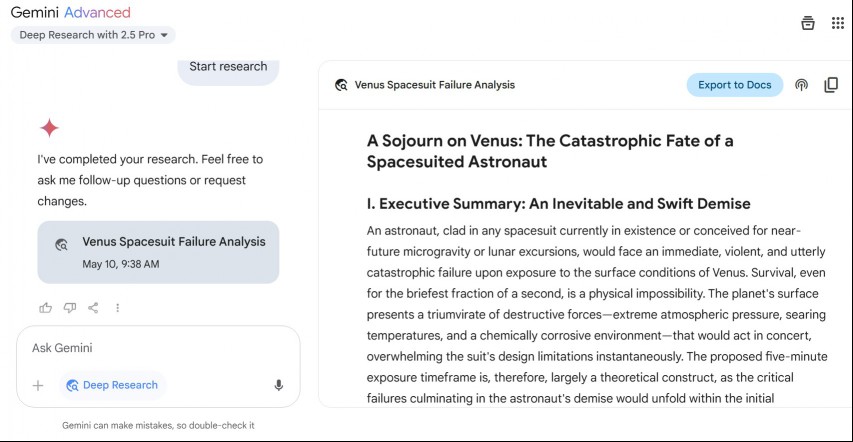
Google launched its deep research tool in December 2024, introducing the feature to the consumer space as part of its paid Gemini Advanced AI chatbot tier, which costs $20. The feature is available across all tiers, with the free option having a usage limit of five reports per month.
Deep research provides expert-level analysis of a topic after referencing dozens to hundreds of sources throughout the internet. Gemini runs deep research on its most advanced AI models available, which allows the feature to maintain its edge. The launch of Gemini’s deep research propelled other brands to release similar features of their own.
OpenAI launched its deep research feature in February 2025, and the tool gained a lot of attention due to being priced alongside the $200 ChatGPT Pro tier. As the brand introduced its new reasoning models that powered the tool, it quickly expanded availability to ChatGPT Plus subscribers at $20 per month, and then to free users. Notably, free deep research users have a usage limit of five queries per month, while ChatGPT Plus users get 25 queries per month, and ChatGPT Pro users get 250 queries per month.
Who does it better? Tie
I tested both deep research features with a unique but implausible science-based question, posing, “What would happen if you spent five minutes on Venus wearing a spacesuit?” Notably, I have the free version of ChatGPT, but I have Gemini Advanced. The ChatGPT deep research query completed much faster; however, it was shorter overall. ChatGPT took a more creative flair, using its image generator to add prospective images of this potential fated space trip, including what it might look like on Venus and the “Newtsuit” that a person might wear to attempt a voyage. The ChatGPT paper has calculations throughout. As a science enthusiast, not an aficionado, they’re just gibberish to me, but we’re going to assume they mean something.
The Gemini deep research query took much longer to complete, probably about seven minutes if I had to guess, but it is rather long and includes detailed mathematical calculation tables. Glossing over the paper, I noted that it also has detailed sections about the structure of the suit. It’s a lot more composed with several sections, breaking down the timing of events and details about the astronaut’s experience.

OpenAI introduced its ChatGPT chatbot in November 2022 and quickly became an industry darling among consumers and enterprises. The chatbot seemingly solved the question of what happens when computers become aware; however, we would quickly become privy to the concept of large language models (LLMs), and how they are trained on human data. This didn’t stop users from signing up for the chatbot in the millions, from one million users in the first five days of availability to 100 million in the first two months. Rapidly hitting milestones, the tool has surpassed 500 million monthly active users in April. OpenAI’s CEO, Sam Altman, has inadvertently hinted that ChatGPT’s user base has doubled and could be anywhere between 600 million and 1 billion weekly active users. However, this statistic has not been legitimized.
Since its time in the spotlight, OpenAI has introduced numerous new features to its chatbot, including Plus and Pro subscription tiers, reasoning models that can describe the thought process behind their results, and more powerful image generators that have spiked ChatGPT’s popularity, to name a few.
Google introduced its Gemini Chatbot in December 2023, after its Google Bard research launch phase. Gemini has many of its own proprietary AI models that serve different purposes, including those best for coding, creativity, and image generation. In addition to its chatbot, Google offers deep AI integration into its Google Workspace apps, allowing you to use Gemini in Gmail, Docs, and other productivity spaces where the tool might be beneficial. Similarly, Google benefits from being able to integrate AI natively into its Chrome browser and Google Search engine.
Recent reports indicate that the chat has amassed 350 million monthly active users and 35 million daily active users as of March 2025. While it trails behind heavy hitters such as ChatGPT and Meta AI in terms of user numbers, it has grown in popularity in recent months, having seen growth from 9 million daily users or 90 million monthly in October 2024, to approximately 35 million daily users in early 2025.
Who does it better? ChatGPT
I use Gemini more often when I happen to use AI, likely because I am deeply integrated into the Google ecosystem and because I have Gemini Advanced. However, I find Gemini has more guardrails against what it allows the chatbot to process. I didn’t perform any tests for this segment, but in my overall experience, ChatGPT is more willing to fulfill seemingly innocent requests that Gemini might restrict.
For me such requests have included things having to do with my interest in astrology, or asking it questions about Weight Watchers points for my mother. For the latter, it responded that the points information was copyrighted, when you can find the same details on Google Search. Sometimes the issue resolves when I switch to a less powerful AI model in Gemini, but I consider as the chatbot updates, those models eventually won’t be available.
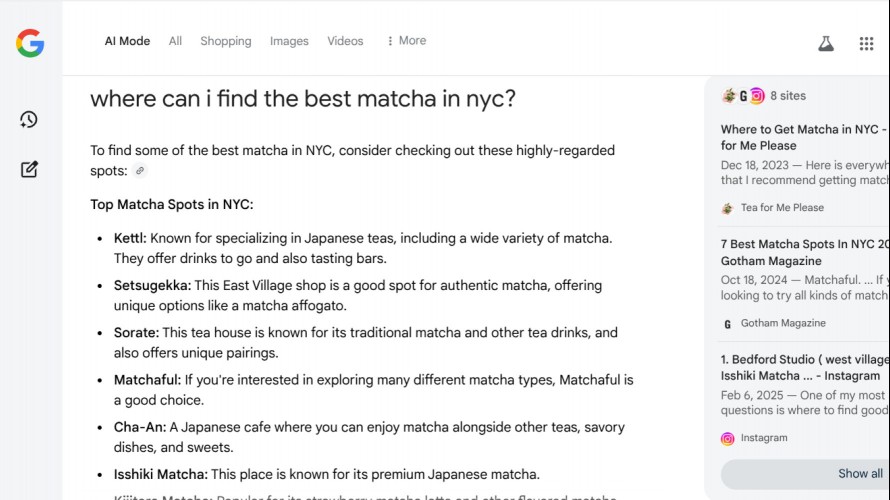
Google made its AI mode feature for Google Search available in March 2025, first as a preview for its Google One AI Premium subscribers. However, the tool has slowly become more accessible to general Google users. Despite having its standalone Gemini chatbot, the tool works like a chatbot integration within Google Search, allowing you to insert contextual prompts and receive detailed text, image, and hyperlink results, similar to ChatGPT Search.
After opting into the AI mode experience through your Google account, you will see an AI mode icon in the upper left corner of your Google Search, where you find link options including Places, Maps, Images, and Shopping. Select the AI mode option to bring up the chatbot and input your query. I used the prompt “Where can I find the best matcha in NYC?” AI mode gave me an extensive list of 10 establishments, organized by three choices for the “traditionalist,” three for the “adventurous,” and four “notable mentions.” Additionally, several sources were prominently linked within the results, including YouTube videos.
ChatGPT Search’s results included six establishments, which are pretty much the same highlighted in the AI mode list. The results include more conspicuous sources, but they are there. A plus is that the options detail prominently the neighborhoods in NYC where the shops are located, or whether they have multiple locations. It also included a highlight list of shops, which essentially repeated locations of the main list.
Who does it better? AI Mode
This portion was close to tied, since the results were so similar. However, I chose AI mode due to it giving a more comprehensive list of options. This is similar to the ChatGPT Search and Google Search section, the former consolidates options. I first started with AI mode on a mobile device, which gave me the traditionalist and adventurous options. However, moving over to a computer, I got an even longer, more extensive result of 13 matcha spots, sorted by the seven top-rated and six more highly recommended, with sources more neatly curated to the right. AI mode also allows you to navigate with that prompt throughout the other options within Google Search to gather more information. It works on both desktop and mobile, but I see this being especially beneficial for mobile. You can start in AI mode and switch to Maps, and find directions to the shop location you desire seamlessly. You would have to do a follow-up query in ChatGPT Search, asking for the location of a specific shop to get that information, and the chatbot will respond with text information, in addition to a Maps link and a link to the establishment.
“If you’re not paying for the product, you are the product.” Bogdan Onikiienko, an ...
Just over a year ago, Apple Intelligence was announced. It continues to be somewhat of a �...
OpenAI is reconfiguring its rollout plan for upcoming AI models. The company’s CEO, Sam ...
Google’s Gemini AI has steadily made its way to the best of its software suite, from nat...
...
AnthropicThough it may not capture as many headlines as its rivals from Google, Microsoft,...
Comments on "Key ChatGPT and Gemini features compared. Who did it better?" :